Monday, September 30, 2013

Walking on the Line - in the Atrium


Walking on the line is one of those iconic primary Montessori experiences - that fades away in elementary.

Yet I still see the need for it in us all: children and adults alike.

Past Seeking the Plan of God posts on the line:
Adding the Line
Anecodotes
Some background

My returning Level 3 children this year - in all 4 level 3 groups I have - requested the line on the first day. They knew it - they loved it - they gained so much from it.

The relaxation; the challenge; the inner balance it achieves especially in these level 3 children whose bodies are growing faster than they can handle and whose emotions are being affected by new hormones.

This year, I am changing the line to a ribbon - leftover from creating a Fettuccia a few years ago. Our carpeting does not hold tape well in the atrium I can place it permanently; the other two atrium spaces, we are not allowed to have tape on the floor.


Saturday, September 28, 2013

Prayer Table Decorating


One of the work options in the atrium is to set up the prayer table - in my level 3 atrium, 2 of the first few children to come in can choose to set it up; in the combined atriums, it is typically the children planning communal prayer who decorate or rearrange what is there. Slowly, my older level 1 children will begin setting up a simple prayer table as well.

It always begin with a cloth, includes a Bible and a candle - from there, is anyone's imagination where it will go.

This is a prayer in itself as they select their items, discuss where items will go, and create something that is worthy enough to bring our minds and hearts to communication with God, the angels and the saints.

I love to see the results - especially from children who have tougher outer layers or those who are more quiet and less expressive. This year, I hope to document each created prayer table.


Thursday, September 26, 2013

Atrium for the Year

I am not sure how I have been so blessed! I am in the atrium 5 days a week now with public school, homeschool, private school - two different cities with very different cultures - and I get all three age groups!

I am so excited to be back with level 1 again this year - I have not been full-time with a full group of level 1 for a while now; and I have missed it. I just love seeing the children's personalities emerge as they normalize, deepen concentration and learn about their faith on a level that most of us weren't trusted with at the same age. SO beautiful!

I have groups of children that are combined level 2 and level 3; each group has a separate sacramental preparation and one group will be starting soon.

Finally, I have groups of just level 3 children, with only one "new-to-atrium" child per group, which makes an amazing difference over last year, when the 4th graders had been in atrium since kindergarten, and the 5th/6th had only had sacramental preparation in the atrium 3 and 4 years previously. They got right to work the very first day of class - but more on that in another post.


Wednesday, September 25, 2013

Sweet Concentration

I have been slow in picking up the blog this year - with 5 days a week of atrium, 2 home businesses, homeschooling, family and dear friends - well, we're focusing on living life more than recording it ;)


Thus, my first post of the school year arrives - and is likely to be my FAVORITE.

On the move. Usually on the move. 
I am officially back in level 1 this year with a wonderful group of 2-6 year olds. The youngest of the bunch is also the most energetic - but he sure know what he's about! He listens to every word I say, makes himself understand in the sweetest of ways, and loves to make sure you know he is present.

He set up the first altar work our second week of class - and gestured to me to light the candles. I still can't figure out how he did it, as I was on the other side of our very large atrium, but he did it!

I lit the candles for him, after a bit (we reviewed the names of the items first - he knew them all, but was slower with the chalice and paten) - and he wanted to snuff them. I had shown the children the week before, but he had not had a turn, as I wanted to "show" them several times before starting with the oldest children to snuff.

Well, this was his work and he was ready. So I let him snuff the candles - and I observed.
(Montessori principle: observe and respond and observe some more)
We lit and snuffed the candles 3 times over.

Enough said. 


Lesson confirmed:
Observe. Trust.
Lay a strong foundation.


Thursday, September 12, 2013

What is the Bible? Study Cards - Command Cards

Several years ago, I came across some Bible study cards. I edited them and began using them at home with my son. I am not sure of my original source, but I know I did not purchase them... and I've edited a bit. So I think I am ok to share these for free :)

Then one of our local atriums had a situation that these cards seem perfect to fulfill - so I edited them a smidgeon again, re-printed and sent them over.

The oldest children in level 2 and our level 3 children heavily utilize them to get their hands back into the Bible, seeking, exploring, organizing and truly experiencing the Bible.

They are in need of another revision! Very soon, I will be updating the set to include a "Part 2" for children who have had them for a while and are looking for deeper work. I have taken some ideas from the children to implement and am currently working a couple of groups of children who are revealing to me the next steps in this work.

While these are not an official atrium material, we are using them in level 2 (for the 3rd graders) and in level 3 (for all those who have not yet done them, or it has been a while and they need a reminder).

I would love the feedback of others as well!

What is the Bible? Study Cards


Monday, August 5, 2013

Cosmic Education in the Christian Profession of Faith


We believe in God, the Father Almighty,
    Creator of Heaven and of Earth:
         of all things visible and invisible.

~First lines of the Nicene-Constantinopoitan Creed (Nicene Creed for short)


Some people, when first approaching Montessori and Catechesis of the Good Shepherd, are uncomfortable with the notions of "cosmic education" - doesn't this all sound rather New Age? No! To the contrary, our very foundation is the Creator Himself! God as the Holy Trinity. Maria Montessori was a Catholic; even her final letter/address out to the world was addressed to catechists passing on the Truths of the Faith. Her foundation was Christ, and Christ is the center of the Catechesis of the Good Shepherd.


From the Catechism of the Catholic Church on "The Visible World"
See this link for the entire section on "Heaven and Earth": http://www.vatican.va/archive/ENG0015/__P1A.HTM


II. THE VISIBLE WORLD

337 God himself created the visible world in all its richness, diversity and order. Scripture presents the work of the Creator symbolically as a succession of six days of divine "work", concluded by the "rest" of the seventh day.204 On the subject of creation, the sacred text teaches the truths revealed by God for our salvation,205 permitting us to "recognize the inner nature, the value and the ordering of the whole of creation to the praise of God."206

338 Nothing exists that does not owe its existence to God the Creator. the world began when God's word drew it out of nothingness; all existent beings, all of nature, and all human history are rooted in this primordial event, the very genesis by which the world was constituted and time begun.207

339 Each creature possesses its own particular goodness and perfection. For each one of the works of the "six days" it is said: "and God saw that it was good." "By the very nature of creation, material being is endowed with its own stability, truth and excellence, its own order and laws."208 Each of the various creatures, willed in its own being, reflects in its own way a ray of God's infinite wisdom and goodness. Man must therefore respect the particular goodness of every creature, to avoid any disordered use of things which would be in contempt of the Creator and would bring disastrous consequences for human beings and their environment.

340 God wills the interdependence of creatures. the sun and the moon, the cedar and the little flower, the eagle and the sparrow: the spectacle of their countless diversities and inequalities tells us that no creature is self-sufficient. Creatures exist only in dependence on each other, to complete each other, in the service of each other.

341 The beauty of the universe: the order and harmony of the created world results from the diversity of beings and from the relationships which exist among them. Man discovers them progressively as the laws of nature. They call forth the admiration of scholars. the beauty of creation reflects the infinite beauty of the Creator and ought to inspire the respect and submission of man's intellect and will.

342 The hierarchy of creatures is expressed by the order of the "six days", from the less perfect to the more perfect. God loves all his creatures209 and takes care of each one, even the sparrow. Nevertheless, Jesus said: "You are of more value than many sparrows", or again: "of how much more value is a man than a sheep!"210

343 Man is the summit of the Creator's work, as the inspired account expresses by clearly distinguishing the creation of man from that of the other creatures.211

344 There is a solidarity among all creatures arising from the fact that all have the same Creator and are all ordered to his glory: May you be praised, O Lord, in all your creatures, especially brother sun, by whom you give us light for the day; he is beautiful, radiating great splendour, and offering us a symbol of you, the Most High. . .
May you be praised, my Lord, for sister water, who is very useful and humble, precious and chaste.
May you be praised, my Lord, for sister earth, our mother, who bears and feeds us, and produces the variety of fruits and dappled flowers and grasses. . .
Praise and bless my Lord, give thanks and serve him in all humility.212

345 The sabbath - the end of the work of the six days. the sacred text says that "on the seventh day God finished his work which he had done", that the "heavens and the earth were finished", and that God "rested" on this day and sanctified and blessed it.213 These inspired words are rich in profitable instruction:

346 In creation God laid a foundation and established laws that remain firm, on which the believer can rely with confidence, for they are the sign and pledge of the unshakeable faithfulness of God's covenant.214 For his part man must remain faithful to this foundation, and respect the laws which the Creator has written into it.

347 Creation was fashioned with a view to the sabbath and therefore for the worship and adoration of God. Worship is inscribed in the order of creation.215 As the rule of St. Benedict says, nothing should take precedence over "the work of God", that is, solemn worship.216 This indicates the right order of human concerns.

348 The sabbath is at the heart of Israel's law. To keep the commandments is to correspond to the wisdom and the will of God as expressed in his work of creation.

349 The eighth day. But for us a new day has dawned: the day of Christ's Resurrection. the seventh day completes the first creation. the eighth day begins the new creation. Thus, the work of creation culminates in the greater work of redemption. the first creation finds its meaning and its summit in the new creation in Christ, the splendour of which surpasses that of the first creation.217

IN BRIEF

350 Angels are spiritual creatures who glorify God without ceasing and who serve his saving plans for other creatures: "The angels work together for the benefit of us all" (St. Thomas Aquinas, STh I, 114, 3, ad 3).

351 The angels surround Christ their Lord. They serve him especially in the accomplishment of his saving mission to men.

352 The Church venerates the angels who help her on her earthly pilgrimage and protect every human being.

353 God willed the diversity of his creatures and their own particular goodness, their interdependence and their order. He destined all material creatures for the good of the human race. Man, and through him all creation, is destined for the glory of God.

354 Respect for laws inscribed in creation and the relations which derive from the nature of things is a principle of wisdom and a foundation for morality.


Footnotes:
204  Gen 1:l -  2:4.205 Cf. DV 11.206 LG 36 # 2.207 Cf. St. Augustine, De Genesi adv. Man 1, 2, 4: PL 34, 175.208 GS 36 # 1.209 Cf.  Ps 145:9.210  Lk 12:6-7;  Mt 12:12.211 Cf.  Gen 1-26.212 St. Francis of Assisi, Canticle of the Creatures.213  Gen 2:1-3.214 Cf.  Heb 4:3-4;  Jer 31:35-37;  33:19-26.215 Cf.  Gen 1:14.216 St. Benedict, Regula 43, 3: PL 66, 675-676.217 Cf. Roman Missal, Easter Vigil 24, prayer after the first reading.

Monday, June 3, 2013

Pentecost 2013 - 3 Weeks of Depth


This past school year, Easter/Pentecost 2013, we received a fantastic blessing in two of the atriums I had: TIME. We ended both the third full week of May, following Pentecost. Most parish atriums end the year in April or the 1st or 2nd week of May - almost always before Pentecost and some years (like 2014) more than a month before Pentecost.

SO - we used that time! THREE WEEKS OF IT!


WEEK 1: Old Testament
First we introduced the Scripture for the gifts of the Holy Spirit - in prophet-fashion.


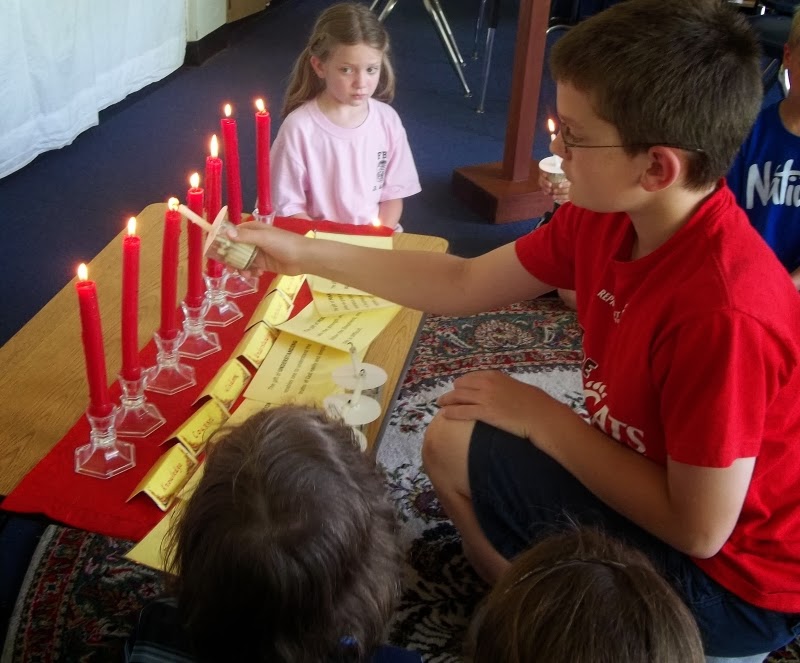
We set out a candle for each gift - did not light them this time. We labeled and discussed each gift - by definition and example. We then spent some time discussing these gifts, what they mean on different levels for a level 2 (ages 6-9) and a level 3 (ages 9-12) child (I also had some level 1 children in this group!). I sent them home for the week to contemplate these gifts and look at situations they are in, to ascertain which gifts are needed in particular situations.

For this group of children, we used the names of the Gifts as outlined by Isaiah in chapter 11 verses 2 and 3:

  • Wisdom
  • Understanding
  • Counsel
  • Strength
  • Knowledge
  • Fear of the Lord
  • Delight in the Fear of the Lord (Awe and Wonder)


WEEK 2: New Testament
The following week, we read and meditated upon the New Testament Scripture passages from the Acts of the Apostles (the Descent of the Holy Spirit upon the Apostles). During our discussion, we brought in other mentionings of the Holy Spirit throughout the Gospels - the ones the children honed in on:

  • descent of the Holy Spirit upon Our Blessed Mother at the Annunciation/Incarnation
  • the Holy Spirit appearing as a dove at the Baptism of Our Lord
  • the Holy Spirit filling John the Baptist in his mother's womb - and Elizabeth's resulting Canticle
We considered each gift again - in light of our contemplation from the previous week at home and in light of the fact that we are each a child of God, called to live as Children of the Light. How shall we spread this light throughout the world? What gift do we need the most right now? 

And we each selected a gift to pray for in the coming week. 

After our group presentation, some of the children (a mix of level 2 and level 3) chose for their personal work to copy and illustrate the names of the Gifts of the Holy Spirit - 1 child wrote out the definitions as well - all of them illustrated their work.  


WEEK 3: The Celebration
Finally in our third week, we had a true Celebration - atrium-style. The children proclaimed the Scripture, proclaimed the Gifts, proclaimed the Church teacher. We set a beautiful prayer table designed by the children and we sang songs selected by the children.

The children selected their Gifts - some different than the previous week, some the same.

always tip the unlit candle into the lit one


Prayerfully considering
Selecting
Calling the children by name to place their candles onto the table
Liturgy of Light style

All of the candles returned according to the gift prayed for
Our beautiful Spirit-filled children! 
They were each invited to snuff a candle
(I forget now who snuffed the remaining ones, since we had 7 extra than the number of children)