Showing posts with label adults. Show all posts

Friday, November 16, 2012

Liturgical Calendar


This post is not about the work of the child, but about the work of the catechist in preparing materials. One in particular.

I LOVE making materials. Making the materials is a meditation in itself and helps the adult to focus on what is the most essential. If you  make your own materials, you will find that you don't find the need to add little embellishments - because frankly, you don't have time, you've already put a lot of work into it and there is a main point to the work that is NOT going to be seen if you add that embellishment.

For example - I once thought, in my haughty adult mind that would impose itself on the children, that all of the international figures for the Eucharistic Presence of the Good Shepherd at level 2 should be clearly identifiable by country or region.

Um. NO.

See this recent response by the children in the atrium - look for their identification of the international figures:
The Good Shepherd will always find me


Yes, I make materials for sale, but I try to price them in such a way that the catechist is still encouraged to make them for him/herself. And I don't make them the same way a volunteer might.

My first chasubles had the edges folded over and stitched - they were not double folded, so the raw edge is still exposed. Most chasubles are made in such a fashion because it WORKS. Those first chasubles of mine are still present and used in a level 2 atrium (having been in 3 atrium spaces prior to that before being replaced by a local volunteer) - and are 8 years old. They are beautiful! All of this despite the fact I would never make them like that again! The ribbon I used down the front has metal wire in it and it holds it shape when bent. ;) But it WORKS for the children.

What more is needed? Yes I make them double-folded chasubles for customers; but they may or may not be Chinese-sweat-shop-perfect - in fact, I hope they're not! Because I am homeschooling my son, running two home businesses to get myself out of school debt and be home with my son, and working in various atriums. I am REAL. I WANT to provide a human touch! It was a person who made these materials - not a machine! Or a copier!


There is one material though - I don't know why I keep making it - the challenge I suppose!? I do not know why I continue to do so. Someone suggested it is because I have made all the mistakes that local woodcutters don't even think of.

The liturgical calendar. I'll be honest: I hate making them.

Here is my first liturgical calendar:
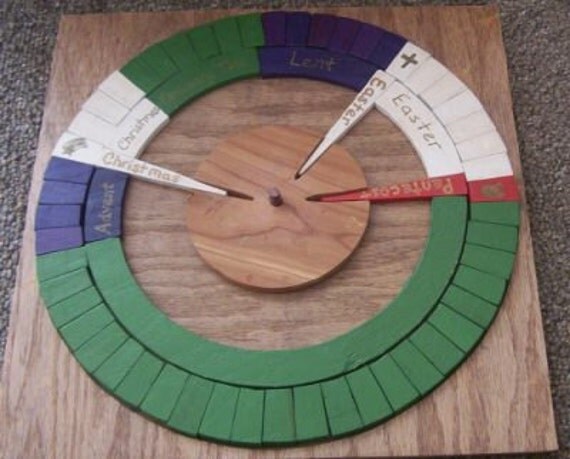
Christian Liturgical Calendar - PAINTED with unpainted available - domestic shipping included
I swore I would never make one again.
At the time they could be purchased for $75. Just buy it next time I said!
The next time I needed one, the prices had gone up to $125+ for unpainted.
The prices have come down SOME since then. But not $75.
I designed this myself WITHOUT the materials manual - just photos
 of the calendar in my level 1 formation course. 
It has 52 Sundays - I only cut 52 Sundays. But I cut them. And I cut them. And I cut them. And I sanded them. And I cut them some more.

WHY!? Because once PAINTED, the paint and polyurethane (A THIN LAYER) adds half a millimeter of thickness to each side. There are 52 pieces. Multiplied by two sides comes to 52 mm which is 2 extra inches of space, which is the equivalent of two whole pieces.


So I started making them that way - cut 54 pieces - since it is hand-cut the pieces are slightly different widths anyway, so move the narrow ones to the shorter seasons, and the wider ones to ordinary time; paint around all but 2 and call it good.
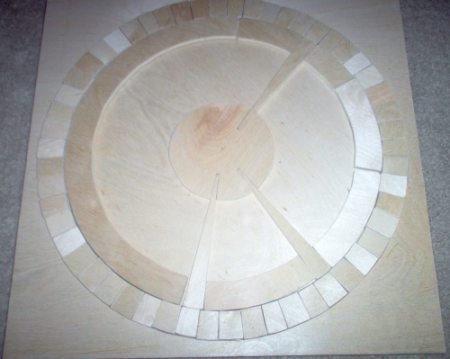

Christian Liturgical Calendar - PAINTED with unpainted available - domestic shipping included


Then I started working on a different saw with different blades. I found that even with cutting 54 and leaving 2 out, I had to NOT paint on the sides to ensure everything fit.

Great! Fine! And I even starting making custom calendars for Godly Play and Young Children and Worship.

(are you starting to add up how many calendars I have had to spend HOURS fixing up so that they worked!? because of all the adjustments!?)

But I finally got it working for several months.


Trouble is - then I switched to using different blades again (not my fault - it's a source thing) - that take out a bit more wood. So even painting the sides of the 52 pieces didn't quite fill it in - it's "ok" but not good enough for "customers". So I set those calendars aside and was able to locate the other blades again. Re-create those particular 3 calendars for customers.

Trouble again is - one of the set-asides was accidentally sent to a customer without the sides painted at all - and now she is accusing me of telling her to paint "thick" layers of paint on the sides (I never said that - I said thin layer), she doesn't believe me that any layer of paint will indeed add up quickly to achieve thickness, she refuses to believe that cutting 54 pieces is necessary to assure proper fit in the final product, among other lack of understanding any explanations given, refunds offered, etc. She has done everything except call into question my Montessori training and my CGS formation (and recognition as a formation leader myself) - perhaps she doesn't know I have those formations. So on the one hand, I am not "offended"; on the other hand, it was an honest mistake on my part, as well as a very real aspect of making such a detailed material. I am making her a replacement (still with 54 pieces) and will use the one she sends back to me in an atrium I know of that WANTS a bit more wiggle room of the pieces because of special needs children.


So here is another scenario - a local wood-cutter made a liturgical calendar for the local level 2 atrium. It is beautiful! As is everything this particular family makes!

But it didn't work.

Why!? Because he cut 52 pieces, his wife painted them, and by the time they were brought to the atrium, one piece didn't fit in AT ALL and a second piece would only go in sideways. So there are 50 functional pieces, with one on its side! I do not blame the wood-cutter - he'd never made such a product and the CRE who commissioned the project probably didn't give him the tips that were provided me in my level 1 formation (and I still made mistakes!!!), nor did she have any experience making such a material to KNOW that there are little issues like this.

So the catechist asked me to fix it - so that no feelings would be hurt anywhere. I quietly measured out the pieces, took the widest ones with me and trimmed them down on my own saw. I brought them back and found they just barely fit (but I'd not yet repainted!), so I took them back and trimmed them down again. They now fit - but it's a year later and we've not been brave enough to re-paint the cut off sections. Problem is: holding those little pieces up to that blade that is WANTING to take off my fingers. I don't want to have to do it again if I paint those sides and find it is too thick again!

Nope. I am sticking to 54 pieces and painting them on all sides. I like my finger tips ;)


UPDATED 2019:
I no longer make them with 54 pieces as I now have a laser cutter to make them just perfect for us!

And I have been making nice deep prisms for several years. So much nicer for the children's fingers.


Sunday, October 28, 2012

Connections and Differences Between CGS Levels

The last couple of years, I have been so focused on helping others understand how CGS builds from level 1 to level 3, so that they become comfortable with the children NOT memorizing the 10 Commandments in levels 1 or 2; become comfortable with their children learning in the earlier ages what we didn't learn until much older (if at all); become aware of the "golden thread" patterns throughout the Catechesis of the Good Shepherd, that encourages parents to continue bringing their children to atrium when a "book-based religious ed" program may have a more convenient schedule. (Some of my explanation of connections are here.)

But in that time, I have lost track of emphasizing the *differences* in each level, especially in level 3. To the point that the adults don't understand that these are not level 1 children anymore, with level 1 needs, or in need of level 1 interactions.


But the children know!

I asked the 4th grade children today what they remember from level 1 or what any of them know from their siblings; the 5th and 6th graders have a few memories from their sacramental preparation time in level 2 and the 4th graders just spent 3 years in that level.

And then they shared what they have found to be different thus far in level 3 - the differences that make it their OWN atrium. That make level 1 and level 2 NOT an appropriate place for them; that make the teaching style of the level 1 catechist and the teaching style of the level 2 catechist no longer an appropriate match for these level 3 children.

Some of their answers:

  • Respect: While they felt respected in all the other atriums, now the respect is that they have a lot more input, they have a lot more to say. The teacher says less and the children think more. 
  • Right/wrong answers: There a lot fewer materials thus far that have matching answers. Even the Plan of God mute does not have to perfectly match the control, as long as they explain why they placed something where they did; then explain why it has meaning at its location on the control. BOTH of those meanings are accurate and have value. 
  • Exploring questions with no or few solid answers: Adults don't have all the answers, but it is obvious that some adults are better at guiding the children towards finding their own answers. They feel more respected by the adults who are able to guide them, than the adults who come in and just tell them what to do. 
  • Pertinent adults: A small group of children had many questions on this matter and asked, "Which adults do we ask for help for what things?" We had a brief conversation about the differences in the types and scopes of the materials used in the atrium and how certain adults had certain pieces that would be of help; other adults could observe and participate with the children. Most adults would just be observing. At this parish there is one trained level 3 catechist, with two adults who have had about half the formation in level 3. These names were identified for the children as sources of assistance. 
  • Time for exploration: All of the children agreed that they appreciated having materials to explore; a brief introduction; then let them go with it; knowing that they need to get ME or other specifically-named adults for a follow-up chat. (UPDATE 10/2013: I no longer have "assistants" but I do prep the other adults to be of specific guidance on specific materials)
Very interesting revelations! And how interestingly they tie into the needs and tendencies of human beings as represented by this age group. 


I introduced to the children today a "suggested work choices list", emphasizing that not only was it not complete, it never would be complete and they were only to use it as a back-up to their own ideas. Every child was invited to enter, quiet themselves either at the prayer table or sitting alone for a moment, then select work. 4 children consulted the list, with 2 of them asking what a material was (for clarification). The assistant got two girls started on exploring a maxim, which led them off into their own study. 

Another group of children studied a timeline book I brought in that ties together various events of Biblical history with what was going on in the secular world. While this is not an atrium material precisely, I allowed them the length of time they desired for this work, because of its direct connection to the Plan of God and other salvation history work, direct tie-in to their school studies, it provided much research fodder for discussions and it will help the oldest ones especially move into the study of the prophets and of typology. 

Another group of children worked with our shorter Fettuccia to get a better feel for it; while yet another group of children spent time with the Plan of God mute. They needed some assistance with this work since about half of the children had not been officially presented with the control. This should NOT have been a problem with this particular group of children, but it seems that they were not sure who to ask for help at key moments and confusion set in when the adults who offered assistance did not get a trained catechist soon enough. I have to admit, it made it very difficult for me to come in and attempt to pinpoint (without boring the children to tears, as well as without making them never want to work with the Plan of God again) where the original point of question lay, because by that point it had been over-laid by so many layers. 


Thus, we had two conclusions that threw my "plans" out the window: 
  1. instead of presenting the Mystery of Faith to small groups, and a prayer table meditation on Creation (to prepare for typology next week); I allowed the children to JUST work. It was intense and wonderful! (by the by, I am happy to throw out my plans for just such a reason!)
  2. And we had a "housekeeping" conversation to answer prevalent questions: 
  • where is the tracing paper hiding? 
  • really, we can move the tables around? really? you mean like this? and like this? (they were testing their boundaries by asking me - I loved that!)
  • and really, we can't sit on the heaters? ;) (in the overly hot room, two boys thought they'd sit on the heaters and block the heat from suffocating everyone!)
  • confirmation for the children that they have been making excellent work choices
  • Most importantly, the discussion points raised above about what kind of atrium is this, what is expected of the children and what is expected of the adults. 

I really got a sense from the children that they left "relieved" - that their needs are going to be met, that their opinions respectfully stated are going to be heard and even addressed, that there was a good reason for some of their discomfort and when properly addressed discomfort can lead to a greater level of being. One girl was even quietly clapping her hands with a look on her face, that said, "YES! Thank you! Thank you for being so honest!" While this was not a deeply theological conversation, it was certainly a meaningful one, a necessary one, and led them to be comfortable in a room that is designed for THEM. 


These children, at this age, can spot a fake a mile away; when they hit 13+, they will spot those fakes 10 miles away. The atrium, for them, is REAL.