Tuesday, March 4, 2014
Plan of God: Vocation
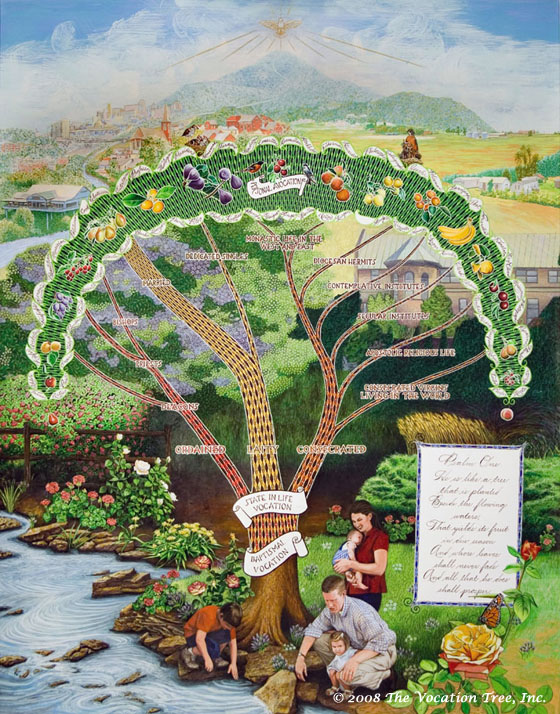
Looking to lay a strong foundation in the youth I work with - for discerning one's life - I came across this beautiful poster:
SUCH a beautiful image! Scripture, all states of life, sacraments are all included in this beautiful image.
More information can be found at VocationTree.com - they have a DVD, resource guide outlining all Scripture and Church documents referenced, and a set of 10 lesson plans for grades 4-8.
(I make no profit from sharing this resource - I just want to share!)
I do not own or use the lesson plans just yet, but I intend to do so. I intend to modify them so that they become an independent work for the children in the level 3 atrium - as a self-study of this poster to extend the work of the Plan of God and the Personal Plan of God.
Saturday, March 1, 2014
Catechesis of the Good Shepherd - Conformity and Red Flags
Some questions that come up that are perhaps not answered in the most succinct way by the CGS National Office:
Does the CGS have an imprimatur?
Short answer: This isn't quite the right question.
Longer answer: CGS as a whole is not a published curriculum or teaching text. Imprimaturs and Nihil Obstats are reserved for publications addressing the Catholic faith. CGS is a method and an environment whose primary texts are the Roman Missal, Sacred Scripture and the Cathechism of the Catholic Church. Thus an imprimatur and nihil obstat do not apply to CGS as a whole.
Do CGS published texts have the imprimatur?
Short answer: Yes.
Longer answer: The published texts regarding CGS have both the imprimatur and the nihil obstat; these texts are not the ones utilized by the students - these are utilized by the adults during their formation, with the primary texts of study being the Roman Missal, Sacred Scripture and the Catechism of the Catholic Church.
Is CGS on the Bishops' approved list of religious ed texts?
Short answer: No.
Medium-Long answer: the Bishops' list is ONLY for *published textbooks* - thus the question doesn't apply to Catechesis of the Good Shepherd - even if the albums (lesson plans) were published, still the only "published text" the child uses is the Holy Bible and the Roman Missal.
Longer answer: Like the Imprimatur and Nihil Obstat, the approval process to get on that list doesn't apply to CGS because the teaching program that the children receive is not a published text. The (arch)bishops of many (arch)dioceses approve the use of CGS and encourage its use among the faithful, but it doesn't fit within the scope of the "approved texts list".
Even longer answer: CGS Letter of Conformity with the CCC
Definitions:
Censor's stamp: NIHIL OBSTAT "nothing stands in the way"
Bishop's stamp: IMPRIMATUR "let it be printed"
UPDATE: 3/3/2014 - I think I might make this post a page of its own.
I am also downloading the protocol used to assess each published text - use the same form and the same format to correlate CGS as it stands at this moment in time. CGS serves to meet the needs of the children - thus is a work-in-progress in the fine-tune details.
But this still compares favorably to published texts - just because a lesson is there, doesn't mean it happens. Due to the 3-year nature of the atrium, if something is "missed" one year, it is picked up the next - or absorbed from the work of older children who already received that presentation.
Monday, February 24, 2014
Altar Serving
My boy!
![]() |
| Kneeling with Father (Legoboy is on the other side, of course) |
![]() |
| Tried to catch them bowing, but missed it. Silly camera! |
Wednesday, February 12, 2014
Atrium Testings
An inherent feature of a Montessori environment is the high amount of real-life immediate feedback on the learning of the children.
Another inherent feature is faith that the planting of seeds will sprout forth in their own due time.
However, when you are in a parish with archdiocese requirements. Guess what? You might have to do outside testing. Same goes for many academic Montessori classes.
The difference? Well, there is no inherent difference actually. Only in the reactions that some people have. School-based tests are taken far more seriously, even if the schools don't always place much weight on the results. In our area, it seems the religious education tests are seen as a nuisance at worst, with meaningless results that no-one cares about. So it's sort of like, "Why bother with them?"
As Montessori as I am - I feel the need to take these tests seriously. Why? Out of respect for the archbishop who is requesting they be done.
And besides - why NOT compare our parish children to others? No names are on these tests, we're not supposed to read the test responses - so none of us will ever know how any given child responded - and frankly, that bothers me. I don't need to know specific children, but I *would* like to know if 90% of my 5th graders can't answer a particular question with the answer "vocation". That means I need to emphasize that word (we utilize it in the level 3 atrium, but from a prophetic standpoint - not yet at a personal level (that is more an adolescent focus, but if our archdiocese wants these children to understand the concept of vocation - then OUR responsibility as catechists is to make it happen)).
For me, this all comes down to respect for authority. The Bishop (archbishop) has jurisdiction over our geographical area. HE is the model of the Good Shepherd for us. Unless he is requesting sinful actions of us, we are to respect his leadership, the educational standards he approves for our area and his authority as a shepherd of us, his flock.
Those test results, if we're going to provide them at all, should be utilized - they are a gauge for how well our parishes are fulfilling the archdiocesan faith formation standards. If we are consistently missing the boat, time to fill in that hole - not simply say, "We just see how the children grow from one testing year to the next year that they test in." Again I say - if there are gaps between what the archdiocese wants and what is testing for as compared to the knowledge our children are consistently showing - the very respect due to the diocesan leadership is to fill those gaps.
Here I paste a portion of a recent e-mail message:
Another inherent feature is faith that the planting of seeds will sprout forth in their own due time.
However, when you are in a parish with archdiocese requirements. Guess what? You might have to do outside testing. Same goes for many academic Montessori classes.
The difference? Well, there is no inherent difference actually. Only in the reactions that some people have. School-based tests are taken far more seriously, even if the schools don't always place much weight on the results. In our area, it seems the religious education tests are seen as a nuisance at worst, with meaningless results that no-one cares about. So it's sort of like, "Why bother with them?"
As Montessori as I am - I feel the need to take these tests seriously. Why? Out of respect for the archbishop who is requesting they be done.
And besides - why NOT compare our parish children to others? No names are on these tests, we're not supposed to read the test responses - so none of us will ever know how any given child responded - and frankly, that bothers me. I don't need to know specific children, but I *would* like to know if 90% of my 5th graders can't answer a particular question with the answer "vocation". That means I need to emphasize that word (we utilize it in the level 3 atrium, but from a prophetic standpoint - not yet at a personal level (that is more an adolescent focus, but if our archdiocese wants these children to understand the concept of vocation - then OUR responsibility as catechists is to make it happen)).
For me, this all comes down to respect for authority. The Bishop (archbishop) has jurisdiction over our geographical area. HE is the model of the Good Shepherd for us. Unless he is requesting sinful actions of us, we are to respect his leadership, the educational standards he approves for our area and his authority as a shepherd of us, his flock.
Those test results, if we're going to provide them at all, should be utilized - they are a gauge for how well our parishes are fulfilling the archdiocesan faith formation standards. If we are consistently missing the boat, time to fill in that hole - not simply say, "We just see how the children grow from one testing year to the next year that they test in." Again I say - if there are gaps between what the archdiocese wants and what is testing for as compared to the knowledge our children are consistently showing - the very respect due to the diocesan leadership is to fill those gaps.
Here I paste a portion of a recent e-mail message:
It's really, truly not a big deal; there are no consequences for passing or failing - but it is an interesting assessment nonetheless. The questions are not worded with the greatest clarity either so the results will be interesting and we'll leave it at that ;)
However, it is important to realize what the archdiocese thinks is important and to show respect for and obedience to our archbishop, who wants the tests administered and taken seriously.
No, I will not "teach" to the test, but there are a few terms to be incorporated into our usual presentations in such a way that they become familiar to the children - not for the test, but for respect for the authority inherent to our church and archdiocese - you could say that I can, should and DO teach to the archdiocesan standards, with which the test is mostly correlated:
- evangelize
- evangelization
- vocation (in a more personal sense than our prophet studies)
- evangelist (as in the Gospel writers)
- specifically listing the types of prayers
- familiarity with the basic hierarchy of the church and incarnation.
These are all CONCEPTS we already cover - and cover quite well when the children are engaged; but we don't always use these terms in a way that translates into what non-atrium children are speaking (this happens in academic Montessori environments too).
Regarding those standards - as compared to the atrium:
No curriculum fits the standards to a T. There are approved published texts, but none are a perfect match. Thus there will be gaps between the book-learning and the arch/diocese standards (same thing happens in academic schools).
As a Montessori environment, the atrium (just as an academic Montessori class) provides several wonderful blessings --- not only can we provide what the universal child needs at a particular stage of development, honing in on the developmentally appropriate key tenets of our Faith, but we can also meet the needs of individual children and their particular interests. In addition, we have the benefit of ensuring that any local educational standards can be met 100%. That doesn't mean every child "gets" or understands or retains everything, but that we are indeed able to provide everything - and at least plant seeds for later development.
Items added to the atrium to match the archdiocese standards:
- the booklet on the types of prayer
- booklet on the hierarchy of the Church
- something on vocations
- I still need to determine the best route for introducing the social justice principles into our particular environment - likely with the virtues work, but I'm not 100% sure yet.
Sunday, February 9, 2014
When Lighting the Paschal Candle...
...be sure to snuff it out.
72 hours later:
(pile of wax removed from the side, candle removed from base)
For perspective:
Maybe 1/3 gone? Much less than the half I thought it was until I compared the actual photos.
Thank you God for your goodness and grace - and your prompting to keep school open on a day everyone around us closed.
Thursday, February 6, 2014
Sacramental Preparation: Reflections
I'll say it upfront: the ideal retreat layout is ideal for a reason - because it works.
However, in the United States, we have this tendency to think that we are so special, that what works for the universal child can't possibly work for our special American kids. We must always be modifying-modifying-modifying.
I say that entirely seriously - we truly believe that about ourselves and about our children! I catch myself doing it. all. the. time. It annoys me to no end, yet I'm indoctrinated into it because this country is my earthly home.
Reality-Check: Multiple Parishes and Dioceses:
With that said, the atrium situations I am in right now, I am not ready to rent out a retreat center for 4 long days (the ideal) and try to coordinate across several parishes (since one of the dioceses I am in requires 1st sacraments to be done in one's own parish - just about ZERO exceptions --- CGS experience would not be an acceptable exception) and three dioceses.
With the variety of parishes the children attend, some children did Reconciliation in December, some in January, 1-2 in February, the rest in March or more likely April. First Holy Communion will be in early May for just about everyone due to the Lenten/Easter schedule this year. So if we could have coordinated Reconciliation, we MIGHT have been able to coordinate retreats with Communion - but no, because the parents want family time the weekend of First Holy Communion.
The Retreats:
The ideal: 4 full days leading up to and including the Sunday of receiving First Holy Communion. Thursday, Friday, Saturday 8am-8pm (or so) and Sunday from before Mass until several hours after Mass, returning to the atrium or the retreat area for a post-communion reflection. The children LOVE this experience! Parents not so much - because we (I include myself in this!) want the fancy dress/suit, the pictures afterward, the party, the celebration - the outer JOY! to express our inner joy.
Should this time of sacramental celebration be focused on the child's reception - internal growth in the faith? Savoring that spiritual moment and not clogging it up with outer signs of joy?
Our Experience:
In a way, my son's experience was sublime in that regard. His first Reconciliation was with a wonderful priest friend (and spiritual director) of ours, who traveled across the country (for other reasons) and coordinated hearing Legoboy's first reconciliation in our local/geographical parish (where he attended CGS, but we were not members). We were within our own diocese, and within our geographical parish's boundaries - but not at the parish of our membership and not with the priest associated with a local parish. We received all the appropriate permissions - and it was a quiet day, with no one else present in the church. We went out to lunch together afterward - just the three of us.
Focus on the spiritual.
He did the one-day sacramental preparation retreat with his atrium group - a week before they did their First Holy Communion (he did not receive there because he was waiting for another particular special day that was upcoming.... see below). This was his second reconciliation and he had a unique experience at that retreat day.
For First Holy Communion, he received at the cathedral in a neighboring diocese where his Godfather was being ordained a priest. There was no announcement, no banner, no pew decoration, no mention in the bulletin (although his name was mentioned for something else I think), no party for "him" afterward though we had a quiet reception of a few gifts from Godfather at one point and the priest friend from above at another time (he also heard my son's confession again before the ordination Mass began).
We received all the necessary permissions there as well. Intricate to plan, but quiet for the child.
Focus on the spiritual.
He LOVED it.
We had a small party in our home the following day for local friends and parishioners from our parish. Two weeks later, we had his party in another state with the rest of our friends and family. He enjoyed the parties and everyone enjoyed sharing this moment with him.
But the focus on the "day of" was on the sacrament itself.
As it should be.
The White Garment:
The "ideal" in CGS is for the children to wear their white garments received after Reconciliation on Saturday - to their First Holy Communion on Sunday. No fancy dress or suit; everyone dressed in a long white flowing garment - think something like altar servers.
I like the concept.
But honestly - I like the dress-up too! This year, I am blessed with the opportunity to make a beautiful veil for a wonderful young lady receiving her sacraments for the first time. I have not seen her dress, but I am sure it is lovely - and special - worn by others in her family before her.
There is something special about having that connection with our immediate family AND with the universal church. I don't know if *I* could give that up for the sake of the children wearing a simple white garment during their First Holy Communion Mass.
But the children get it. White garment - all the parables, all the teaching, Baptismal garments, etc. White garment. Unstained. They GET it. They go deep with it.
I have a tough time with this one - I see the benefit both ways - and I want to do it both ways!
However, in the United States, we have this tendency to think that we are so special, that what works for the universal child can't possibly work for our special American kids. We must always be modifying-modifying-modifying.
I say that entirely seriously - we truly believe that about ourselves and about our children! I catch myself doing it. all. the. time. It annoys me to no end, yet I'm indoctrinated into it because this country is my earthly home.
Reality-Check: Multiple Parishes and Dioceses:
With that said, the atrium situations I am in right now, I am not ready to rent out a retreat center for 4 long days (the ideal) and try to coordinate across several parishes (since one of the dioceses I am in requires 1st sacraments to be done in one's own parish - just about ZERO exceptions --- CGS experience would not be an acceptable exception) and three dioceses.
With the variety of parishes the children attend, some children did Reconciliation in December, some in January, 1-2 in February, the rest in March or more likely April. First Holy Communion will be in early May for just about everyone due to the Lenten/Easter schedule this year. So if we could have coordinated Reconciliation, we MIGHT have been able to coordinate retreats with Communion - but no, because the parents want family time the weekend of First Holy Communion.
The Retreats:
The ideal: 4 full days leading up to and including the Sunday of receiving First Holy Communion. Thursday, Friday, Saturday 8am-8pm (or so) and Sunday from before Mass until several hours after Mass, returning to the atrium or the retreat area for a post-communion reflection. The children LOVE this experience! Parents not so much - because we (I include myself in this!) want the fancy dress/suit, the pictures afterward, the party, the celebration - the outer JOY! to express our inner joy.
Should this time of sacramental celebration be focused on the child's reception - internal growth in the faith? Savoring that spiritual moment and not clogging it up with outer signs of joy?
Our Experience:
In a way, my son's experience was sublime in that regard. His first Reconciliation was with a wonderful priest friend (and spiritual director) of ours, who traveled across the country (for other reasons) and coordinated hearing Legoboy's first reconciliation in our local/geographical parish (where he attended CGS, but we were not members). We were within our own diocese, and within our geographical parish's boundaries - but not at the parish of our membership and not with the priest associated with a local parish. We received all the appropriate permissions - and it was a quiet day, with no one else present in the church. We went out to lunch together afterward - just the three of us.
Focus on the spiritual.
He did the one-day sacramental preparation retreat with his atrium group - a week before they did their First Holy Communion (he did not receive there because he was waiting for another particular special day that was upcoming.... see below). This was his second reconciliation and he had a unique experience at that retreat day.
For First Holy Communion, he received at the cathedral in a neighboring diocese where his Godfather was being ordained a priest. There was no announcement, no banner, no pew decoration, no mention in the bulletin (although his name was mentioned for something else I think), no party for "him" afterward though we had a quiet reception of a few gifts from Godfather at one point and the priest friend from above at another time (he also heard my son's confession again before the ordination Mass began).
We received all the necessary permissions there as well. Intricate to plan, but quiet for the child.
Focus on the spiritual.
He LOVED it.
We had a small party in our home the following day for local friends and parishioners from our parish. Two weeks later, we had his party in another state with the rest of our friends and family. He enjoyed the parties and everyone enjoyed sharing this moment with him.
But the focus on the "day of" was on the sacrament itself.
As it should be.
The White Garment:
The "ideal" in CGS is for the children to wear their white garments received after Reconciliation on Saturday - to their First Holy Communion on Sunday. No fancy dress or suit; everyone dressed in a long white flowing garment - think something like altar servers.
I like the concept.
But honestly - I like the dress-up too! This year, I am blessed with the opportunity to make a beautiful veil for a wonderful young lady receiving her sacraments for the first time. I have not seen her dress, but I am sure it is lovely - and special - worn by others in her family before her.
There is something special about having that connection with our immediate family AND with the universal church. I don't know if *I* could give that up for the sake of the children wearing a simple white garment during their First Holy Communion Mass.
But the children get it. White garment - all the parables, all the teaching, Baptismal garments, etc. White garment. Unstained. They GET it. They go deep with it.
I have a tough time with this one - I see the benefit both ways - and I want to do it both ways!
Thursday, January 30, 2014
Concerns of the Children
At one evening atrium, early in January, I just wasn't prepared for our intended Epiphany celebration. We have many materials and presentations I could do with the children - so I thought we'd start at the prayer table and discern which materials we should work with based on a light conversation.
A fun resource for families that was discussed (and some of the children actually went home and READ!):
Dante's Divine Comedy for Young People
Some literature studies on it:
WELL.....
Our light conversation covered the following topics:
- Let's celebrate Christmas until February 2nd - for the traditional 40 days of Christmas - the original date for the Presentation in the Temple - and because we prepared for approximately 28 days so the celebration can be longer than the preparation time - and so we could actually celebrate True Christmas in the atrium.
- Because what is True Christmas? The coming of the Light into the world - 2000 years ago, at our baptisms, and at the Parousia. We are ALWAYS to be preparing for the Coming of the Light.
- We got to looking at our liturgical calendar (sitting on the prayer table) - Easter is longer than Lent - and we end with a Sunday in red: Pentecost.
- But what about the other red days?
- And why doesn't our calendar show the rose Sundays for Advent (Gaudete) and Lent (Laetare)
- (we reviewed why we use rose and how to know which Sunday is rose and why that Sunday in each season)
- We began reading our Liturgical Colors booklet, going through each color, explaining the significance and definitions of any new words - quizzing on what they already know.
- New terms up for discussion: Requiem Mass, age of reason, children dying before the age of reason, children dying in the womb
- Discussing All Saints Day, followed by All Souls' Day - purgatory came into the conversation. Do you know we have NOTHING in the atrium (officially) on purgatory? On the Church Militant, Church Suffering and Church Triumphant? This is CORE to our faith and we have missed it as an official work in the atrium. Hm.
- So we talked about the 3 portions of the Church; the reality of Purgatory - not as an alternate to Hell, but a place all its own - for purging the remnants of stains from our white garments (tying in to the Baptism studies we've done, the parables we've done that mention white garments such as the Wedding Feast, Holy Communion, Reconciliation, etc.) - as a place that we CHOOSE to go when God pronounces our particular judgment at the moment of death (Heaven or Hell) and we ourselves realize our uncleanliness to be in Heaven - thus we choose Purgatory to finish purging, cleansing - so that we enter the gates of Heaven whiter than freshly fallen snow.
- This led back to the babies who die before being baptized; who die in their mother's wombs. What does the Church teach us about them?
These were 9-12 year olds, entirely guiding the conversation where they wanted it to go.
These were real conversations, real concerns, real questions - real spiritual needs to be addressed.
Thank you Lord for these precious souls before me, revealing to me the core of our Faith, the purest questions we have, and most essential responses.
A fun resource for families that was discussed (and some of the children actually went home and READ!):
Dante's Divine Comedy for Young People
Some literature studies on it:
Subscribe to:
Posts (Atom)


